 Apeswap
 yield farming ties LP staking rewards to active farm incentives
Apeswap yield farming involves staking liquidity provider (LP) tokens in a supported farm to earn its configured token rewards. The original MasterApe system distributed BANANA according to a farm's reward allocation and each participant's stake. Trading fees accrued within the underlying liquidity position, while farming added a separate incentive stream. Following the project's ApeBond rebrand, a surviving farm screen does not establish active emissions. New rewards require an active incentive allocation in the selected farm.
Active incentives and inactive farm positions
An incentive-paying farm distributes rewards to participants who stake eligible LP tokens, while an inactive position may still need withdrawal through its original contract. Incentive farming rewards participants for keeping liquidity available. Ending those incentives changes the earning opportunity; it does not automatically redeem a participant's LP tokens or remove the recorded deposit.
The legacy Farms interface includes Active, Inactive, and Staked filters. A missing card in the active view does not show that the farm returned its LP tokens. The original MasterApe identifies stakes by account and pool, within the network where that contract operates. Account selection and display filters therefore affect which position appears on screen.
Liquidity positions and staking alternatives
LP farming adds an incentive contract to a liquidity position. Legacy V2 liquidity provision supplies both assets in the pool's current reserve ratio and produces fungible LP tokens. These tokens represent a proportional claim on pool reserves. Single-token staking and vesting products use different deposit and ownership rules, including the legacy designs below.
| Position or product | Earning mechanism | Position rules and limits |
|---|---|---|
| V2 liquidity without farming | Trading fees accrue within the pool position. | LP tokens redeem a share of current pool balances. |
| Legacy LP farm | Token incentives follow the farm's reward allocation. | Unstaking returns LP tokens, subject to successful contract execution. |
| Legacy BANANA staking pool | Configured rewards for a single-token stake. | The pool accepts BANANA rather than a pair's LP token. |
| Legacy GNANA staking pool | Configured rewards for a single-token stake. | GNANA's 2% reflection fee applies on staking and unstaking. |
| V3 liquidity at its 2023 launch | The position earns fees from trades that use its selected price range and fee tier. | A position NFT represents the liquidity; staking incentives were absent at launch. |
| BANANA Maximizers | Separate vault strategies compounded BANANA earnings. | The legacy interface marks this product as deprecated. |
| Liquidity Bond | A purchased token allocation vests over time. | LP payment transfers ownership; token claims follow the vesting terms. |
A Liquidity Bond exchanges LP tokens for a token allocation that vests over time. That sale gives up the LP claim used as payment. A farm instead records deposited LP tokens against the participant's stake. This ownership difference also matters in Liquidity Health, which distinguishes project-owned reserves from liquidity attracted through farming incentives.
What determines an LP farm's return?
A farm's return combines changes in the underlying liquidity position with token incentives, less transaction costs and any charges that its contracts apply. The original BANANA farming design allocated emissions through farm weights and each participant's share of the farm. Other deposits can change that share, while allocation changes alter the farm's reward stream.
Annual percentage rate (APR) annualizes reward conditions; it does not fix the future value of tokens received. Reward-token prices affect the value of emissions, while LP-token prices affect the capital used to express the rate. A displayed percentage may include farm incentives, trading fees, or both. Its components determine what income that percentage describes.
Before fees and farming incentives, price divergence can leave a V2 liquidity position worth less than holding the starting tokens separately. This relative shortfall is impermanent loss. A position can rise in dollar value and still trail the same tokens held outside the pool. A growing reward balance alone does not show that incentives offset the gap.
Entry and exit costs also reduce realized proceeds. Gas for approvals, deposits, harvesting, and withdrawals consumes value alongside any contract-specific charges. Frequent harvesting can cost more than the rewards collected. GNANA reflection charges belong to GNANA transactions; they are not a general fee on every LP farm.
The bond-focused transition
The project announced its ApeBond rebrand on October 10, 2023, after introducing Bonds in early 2022. It subsequently reported completion of the BANANA/GNANA migration, with claims through existing Migration Bonds. BANANA Maximizers carry a deprecated label in the legacy navigation. Farming incentives and Bond vesting use different distribution rules. The original farm's eligibility and reward settings govern its remaining positions.
LP-token eligibility and deposit records
Farm eligibility requires the exact LP-token contract configured for that pool on the same blockchain, even when other LP tokens carry similar names. Different pools can issue different LP tokens for the same two assets. The LP token's allowance sets how much the chosen farm can transfer from the approving wallet. That limit concerns transfers of the approved LP token, not every asset in the wallet.
Approval for another spender does not authorize the intended farm, even when both contracts accept the same LP token.
An LP deposit transfers the accepted tokens into the farm. Its recorded staked amount shows the balance used for farm accounting.
Pending rewards track the amount accrued for later settlement. Successful reward-token transfers put paid rewards in the wallet. A farm can show an earned balance even when a submitted harvest transaction fails. The original MasterApe's payment contract sends at most its available BANANA balance. If that balance is insufficient, a successful harvest pays less than the pending amount and clears the unpaid difference from reward accounting.
Unstaking and emergency withdrawal limits
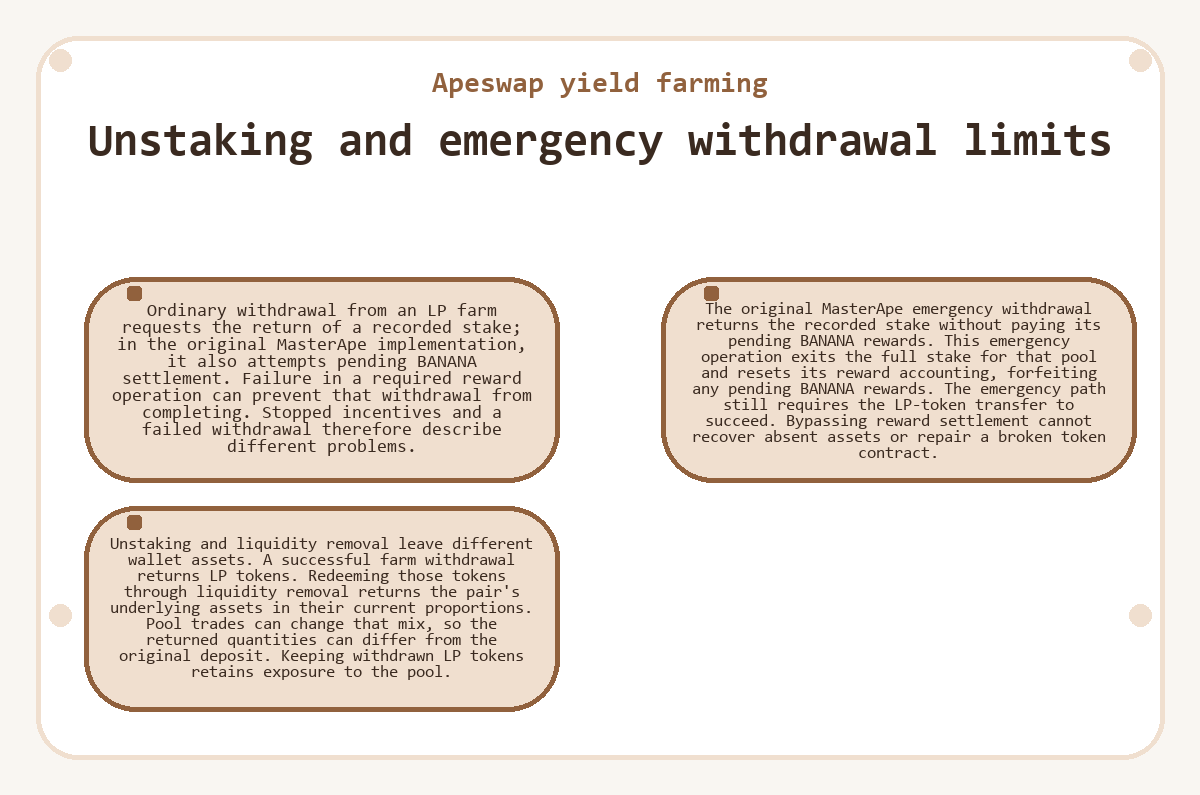
Ordinary withdrawal from an LP farm requests the return of a recorded stake; in the original MasterApe implementation, it also attempts pending BANANA settlement. Failure in a required reward operation can prevent that withdrawal from completing. Stopped incentives and a failed withdrawal therefore describe different problems. The original MasterApe emergency withdrawal returns the recorded stake without paying its pending BANANA rewards. This emergency operation exits the full stake for that pool and resets its reward accounting, forfeiting any pending BANANA rewards.
The emergency path still requires the LP-token transfer to succeed. Bypassing reward settlement cannot recover absent assets or repair a broken token contract.
Unstaking and liquidity removal leave different wallet assets. A successful farm withdrawal returns LP tokens. Redeeming those tokens through liquidity removal returns the pair's underlying assets in their current proportions. Pool trades can change that mix, so the returned quantities can differ from the original deposit. Keeping withdrawn LP tokens retains exposure to the pool.
Still wondering about Apeswap yield farming?
Does harvesting a farm automatically compound its rewards?
The original MasterApe's reward payment sends BANANA to the participant's address without creating additional LP tokens. Increasing the LP stake requires another contribution of the accepted deposit token. Maximizers used separate vault contracts to compound BANANA earnings, and the legacy interface marks them as deprecated.
Which asset covers gas for a legacy BNB Smart Chain farm?
Ordinary wallet-paid transactions on BNB Smart Chain use BNB for gas. That fee asset is separate from both the deposited LP token and the farm's reward token. The transaction estimate reflects gas consumption and the applicable gas price. Holding BANANA or a staked LP balance alone does not provide spendable native BNB.
Do I need to keep BANANA in my wallet while farming with LP tokens?
The original MasterApe LP deposit uses the configured LP token without requiring a separate wallet balance of BANANA. Creating that LP token may require BANANA when the selected pair includes it. A BANANA single-token pool has a different deposit requirement, so its entry rules do not describe an LP farm.
Can every chain in the swap menu support the same LP farm?
A chain's appearance in the swap menu does not establish support for a particular LP farm. Participation requires the matching farm deployment and accepted LP-token contract on that network. The legacy navigation distinguishes primary chains from swap-only chains. Token symbols shared across networks do not make those balances interchangeable.
What happens to an unused LP-token approval after a full withdrawal?
A full farm withdrawal does not automatically revoke an unused LP-token allowance. Remaining permission belongs to that wallet, token, and approved spender, independently of the farm's staked balance. An allowance can remain after the stake reaches zero if the deposit did not consume it. Revoking permission affects future authorized transfers, not ownership of withdrawn LP tokens.
Does ABOND migration completion automatically convert an old LP farm stake?
Completion of the BANANA/GNANA migration does not by itself convert an LP stake into ABOND. Migration Bonds represent allocations created through that program's enrollment process. A farm's LP balance and any BANANA rewards remain different records from an ABOND vesting claim. Holding an old farm position alone therefore does not establish entitlement to migrated tokens.
How do V2 trading fees affect the LP-token balance in a farm?
Trading fees in the legacy V2 model accumulate in pool reserves without automatically increasing a participant's LP-token count. LP tokens represent a proportional claim on those reserves, subject to the pool's accounting. Farm rewards use separate accounting, so an unchanged staked LP balance can coexist with fee income or newly accrued token rewards.