 Apeswap
 evolved from a decentralized exchange into the bond-focused ApeBond ecosystem
Apeswap began as a decentralized exchange and DeFi hub before rebranding as ApeBond, a platform focused on bonds that distribute discounted tokens. The older ecosystem included swaps, liquidity pools, yield farming, BANANA and GNANA staking, lending, and collectibles. ApeBond continues the same project's development through Bonds, swap aggregation, and ABOND-based incentives. These products create different kinds of ownership: a swap returns tokens, a Bond represents a vesting allocation, and locking ABOND creates a separate incentive position.
Token swaps on the same chain or across chains
Token swaps can stay within a blockchain or combine an exchange with a cross-chain transfer through ApeBond's aggregator. The aggregator supports routes involving BNB Chain, Polygon, Ethereum, and Arbitrum. Each route needs compatible source and destination assets. Multi-chain support does not establish that every token or product operates on every supported network.
Slippage describes the price difference between submitting a trade and its confirmation. The amount ultimately received therefore depends on execution terms as well as the quoted exchange rate. The older hub also included Pro Trading for charting and enhanced exchange views. These exchange functions remain distinct from buying tokens under a Bond's vesting schedule.
Bond payments and vesting claims
Bonds are discounted token purchases with delayed release, giving a project funding or liquidity in exchange for a scheduled token allocation. The discount concerns the purchase price relative to the market price when offered. Token prices can fall during vesting, so that initial discount does not establish a profit when tokens become available.
Payment assets
Reserve Bonds
Reserve Bonds accept a specified single asset, such as a stablecoin, in exchange for the project's vesting tokens. The accepted payment asset belongs to that particular offer. This structure lets the project diversify its treasury while distributing its own token over time.
Liquidity Bonds
Liquidity Bonds accept liquidity provider tokens, usually shortened to LP tokens. The project receives ownership of the supplied liquidity, and the buyer receives a vesting NFT. Zap also lets a Liquidity Bond purchase start with a single token.
The NFT holder's claim
A Bond NFT represents the purchased token allocation, and its holder controls claims as tokens vest. ApeBond uses ERC-5725, a transferable vesting NFT standard, for this structure. The NFT and the underlying tokens are different assets: holding the NFT does not make the entire allocation immediately spendable. Its release schedule determines which portion has become claimable.
What changed when Apeswap became ApeBond?
The ApeBond rebrand shifted the DAO's emphasis from its DEX origins toward bonding and project financing. Apeswap announced its rebrand to ApeBond on October 10, 2023. Bonds had joined the product range in early 2022, before the new name. The rebrand retained the same project team and introduced ABOND as a new token. It also provided the context for an opt-in BANANA and GNANA migration. Existing token holdings did not become ABOND automatically when the branding changed.
How did the BANANA and GNANA migration work?
Migration Bonds exchanged participating BANANA or GNANA for ABOND allocations with a chosen vesting term. The October 2023 plan specified a 61-day entry window, with launch subject to governance approval. Linear vesting began on December 12, 2023, at 13:00 UTC. Entering earlier within the migration window did not bring that common vesting start forward.
Unmigrated BANANA remained BANANA. The plan tied ABOND eligibility to entering the migration window; holding the old token alone did not create an allocation.
The selected vesting term and applicable multiplier or lock bonus affected the ABOND allocation. Those incentives changed the allocation, rather than the shared start date. Claiming an existing allocation is a different action from entering a new migration. A notice that ABOND distribution has begun does not itself reopen the historical entry window.
Liquidity pools and the older staking products
Liquidity provision supplies assets to a trading pool and creates an LP-token claim on that liquidity. The original hub paired this function with farms, which accepted LP tokens as the staked asset. Yield farming added token incentives to liquidity provision, making reward eligibility a separate matter from owning a pool share.
Single-token pools used BANANA or GNANA as inputs. Their deposited asset differed from a farm's LP token, even when both products appeared under staking.
The older interface distinguishes active and inactive farms and pools, and it marks BANANA Maximizers as deprecated. A visible product link does not establish an active reward schedule. Pool APR calculations use the reward rate, token values, and the participant's pool share. These inputs can change independently, so an annualized rate cannot describe every position or remain fixed across time.
What does locking ABOND change?
Locking ABOND creates a veABOND position whose points govern True Yield rewards and Ape Tier benefits. The amount locked and the duration multiplier determine those points. Tier benefits include extra Bond discounts outside Solana, while protocol performance influences the weekly reward pool. A larger point share does not fix the monetary size of future distributions.
ApeBond announced the replacement of its BNB-paying Real Yield model on December 11, 2025. True Yield pays rewards in USDT in weekly epochs. The announcement scheduled old-pool migration for December 18, 2025. It warned that users who missed the three-month migration window would forfeit pending rewards from the old tier-staking pools. Governance also uses locked positions and points, giving the token a role beyond purchases and discounts.
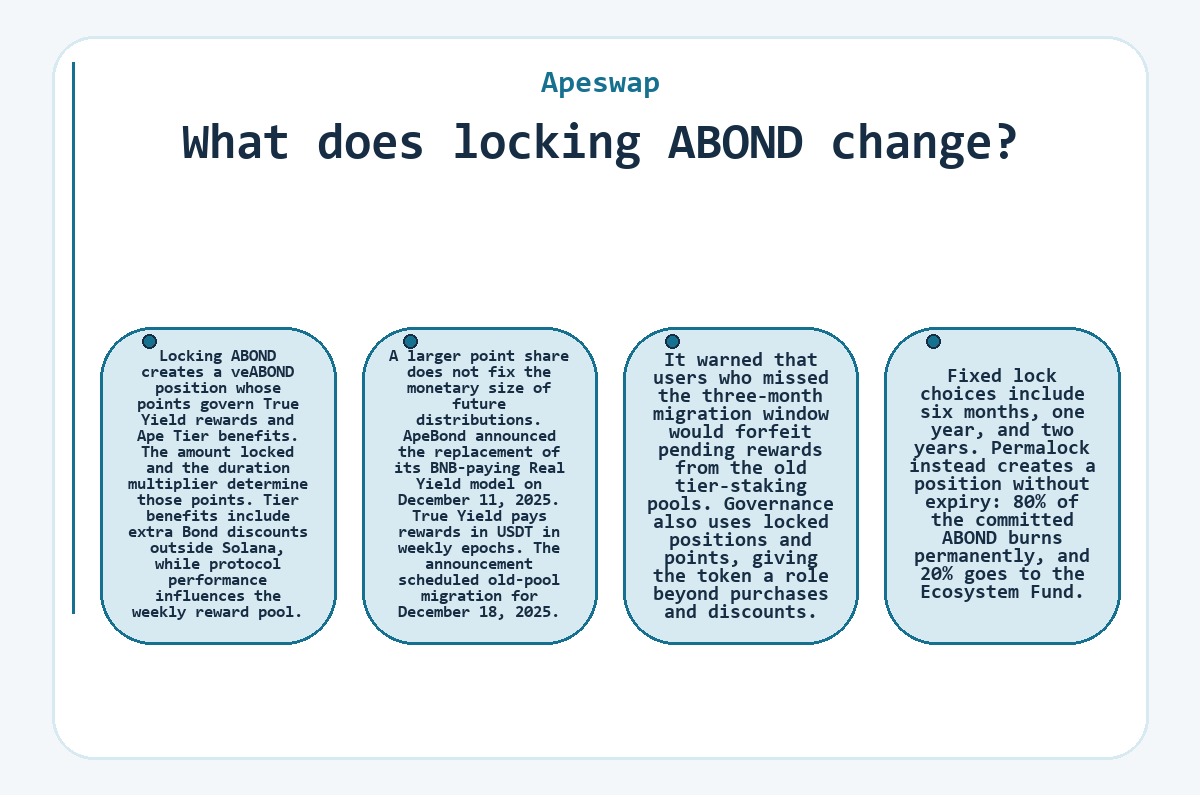
Fixed lock choices include six months, one year, and two years. Permalock instead creates a position without expiry: 80% of the committed ABOND burns permanently, and 20% goes to the Ecosystem Fund.
Lending markets and collectible NFTs
The older Apeswap hub also included a Lending Network for supplying and borrowing assets. BANANA was already an exception during the 2023 rebrand: its borrowing market had been disabled, and the announcement encouraged suppliers to withdraw. That restriction concerned the BANANA lending market, separately from the platform's swap and Bond products.
Collectibles formed another part of the ecosystem, including Non-Fungible Apes and Non-Fungible BANANAs. Those collection NFTs differ from Bond NFTs, whose defining function is a token-vesting claim. The older NFT offering also included an auction mechanism for Non-Fungible Apes.
Liquidity Health and project-owned reserves
The Liquidity Health Dashboard evaluates tokens through liquidity strength, ownership, and concentration. Strength relates available liquidity to market capitalization. Ownership considers the liquidity controlled by a project, and concentration examines how its pools establish trading depth. These dimensions describe a token's liquidity structure; they do not determine its future trading price.
Project-owned liquidity also explains the financing side of Bonds. A Liquidity Bond supplies LP tokens that the recipient project can own and control. A Reserve Bond brings a single asset into its treasury. Partner work also includes advisory and co-marketing services, which remain separate from the financial terms of a purchased Bond.
LP ownership and access to tokens
LP tokens can support different commitments: staking them in a farm, or selling them for a Liquidity Bond. In the farm model, they remain the asset staked for incentives. In the Bond model, the LP tokens change ownership and the buyer receives a vesting NFT.
- Choose a swap when the task is exchanging tokens under a quoted route, without a Bond vesting schedule.
- Treat a Reserve Bond as payment with its specified single asset for tokens that unlock over time.
- For a Liquidity Bond, distinguish the LP tokens paid from the NFT received, including when Zap provides the entry route.
- Read farm rewards against the selected farm's activity and reward rate, separately from the underlying liquidity position.
- Consider ABOND lock duration and Permalock's permanent token disposition before comparing tier benefits.
A Bond's discount, a farm's annualized reward figure, and a True Yield position's point share measure different things.
Before you start with Apeswap
Which fees can an ApeBond swap route include?
ApeBond charges a routing fee on every token swap. DEX fees and any bridge charges depend on the route. A same-chain trade does not acquire a bridge leg merely because the interface supports multiple networks. Slippage describes execution-price movement; it is separate from a service fee collected on the trade.
Can I sell a Bond NFT before vesting finishes?
A Bond NFT can transfer ownership while tokens remain unvested because it uses a transferable vesting structure. The NFT holder controls the unclaimed token entitlement. Selling requires a buyer and a supported marketplace or transfer arrangement; transferability alone does not establish a sale price or immediate market liquidity.
Does ERC-5725 require every Bond to vest linearly?
ERC-5725 permits custom vesting curves and does not require every implementation to use linear release. The 2023 Migration Bonds did use linear vesting. A particular Bond's schedule determines its claimable tokens.
Where has ABOND been deployed?
ABOND's documented token deployments include BNB Chain as a BEP-20 token, Polygon, and Ethereum; these deployments identify the asset's network instances and do not imply that every Bond, staking pool, or legacy product operates on all three networks.
Will adding ABOND to True Yield restart the existing lock?
Adding ABOND to a True Yield position increases its locked amount without resetting the existing lock duration. This behavior differs from the older Real Yield arrangement described in the December 11, 2025 transition announcement. Extending a lock term or choosing Permalock remains a separate commitment from simply increasing the amount.
How was GNANA valued during the 2023 migration?
Each GNANA entered under the 2023 migration terms counted as 1.43 BANANA for migration accounting. That weighting reflected GNANA's burn mechanics and did not establish a permanent exchange rate between the tokens. The selected vesting term and applicable bonuses also affected the resulting ABOND allocation.
Why did Polygon BANANA need different migration arrangements in 2023?
Multichain bridge problems prevented affected BANANA balances from being bridged back to BNB Chain during the 2023 migration. The migration announcement described a ticket-based option for Polygon BANANA. That exception concerned those Polygon holdings; it does not establish an open migration service today or coverage for every other chain.
Can True Yield points decrease while ABOND remains locked?
A time-limited True Yield position can lose points as its lock ages without re-locking. Autolock maintains the lock duration automatically. This affects the points used for reward allocation and tiers; it does not make the locked ABOND a spendable balance or set a fixed payout.